[ Research ]
Crosmos: Organizational Memory for AI Agents
Agent memory has been built for one person. Companies don't work like that.
On this page
Every agent memory system today remembers one person. A company is not one person. Its memory is shared: what the team knows, who said what, and which parts each person is allowed to see.
Crosmos is built for that. It is a shared memory for an organization: many people, one growing record, with permissions built in so each person sees only what they are allowed to, and a full history that can be traced and audited rather than silently overwritten. It finds the right memory 99.7% of the time, answers around 91% of questions correctly on gpt-5-mini, a small model, or 90.8% under an independent gpt-4o grader, and runs a deterministic search that returns the same results for the same query.
1. Personal memory is not enough for teams
A company's useful memory is shared and permissioned. If a sales rep asks "what did we promise this customer," the answer might sit in someone else's conversation, and some of what is stored, this person should not see at all. Existing memory tools model a single user, and none of them treat "what is shared with me" as part of how they search. That is the gap Crosmos is built to close.
2. Memory should be auditable
Crosmos stores memory as a Monotonic Temporal Knowledge Graph. Monotonic means it only ever adds. When a fact changes, the old version is not erased. It is kept and dated, and the new one is layered on top.
Most memory systems update in place. "Works at Google" becomes "works at Anthropic," and the old fact is gone. But people change. They switch jobs, move cities, shift preferences. A system that overwrites can only ever tell you the current state. A monotonic graph tells you the whole story: what is true now, what was true before, and when it changed. Recent facts surface first in search, older ones fade but stay reachable when the question is about the past.
Every fact also records two times, kept separately: when the event happened, and when it was said. Someone might mention in June that they started a job in May. The two dates serve different jobs, one for reasoning about time, one for ranking by recency, and keeping them apart is what lets the system answer time questions correctly.
The graph is not the whole memory, it is a view onto it. Underneath sits the real record: the facts and episodes exactly as they were observed, each with its timestamps and a link back to where it came from, a conversation, a document, a Slack message, an email. Every connection in the graph points back to the memory it was drawn from, and every memory points back to its source. Any answer can be traced all the way to the original context it came from.
That traceability is the point. For a person using an assistant, memory is mostly about convenience. For a company, memory is about trust: being able to audit a past decision, reconstruct how something changed, and explain why the agent said what it said. A system that overwrites cannot do any of that. One that preserves history can.
3. How search works
A few pieces:
- Spaces. Each organization gets its own space. Every fact, person, and connection lives inside it.
- Facts. Short, self-contained statements ("Maria leads the Acme account"), cleaned up at save time so each one makes sense on its own, an approach related to contextual retrieval 1.
- Connections. Links between people and things, each with a confidence and a date, so when a fact changes over time we can tell which version is current.
- Permissions. Every fact is either shared with the whole organization or owned by a person. Search only ever returns what the asker is allowed to see, and that rule is part of the search itself rather than a filter added afterward.
Search runs four approaches at once: meaning-based search, plain keyword search, a walk over the connection graph, and a date-aware pass for time questions. Their results are combined, nudged slightly toward recent items, and the top handful are returned. Retrieval is deterministic: the same query returns the same results.
That determinism is deliberate. Search does not rewrite the query with a language model, generate a hypothetical answer to search with, or loop, so it adds no extra cost or latency on each request and does not shift when a prompt is tuned. Long contexts and noisy retrieval are known to degrade answers 2, so the job of search is to hand the answering model a small, correct set, fast, every time, the same way twice.
The four signals
Each signal looks for the answer a different way, so between them they cover each other's blind spots. Meaning-based search embeds the question and matches it against the stored facts, catching paraphrases that share no words with the question. Keyword search runs full-text matching over the fact text, so exact names, identifiers, and rare terms that embeddings blur are still found. The graph walk starts from the people and things the question names and follows their connections outward, hop by hop, reaching facts that are related but never directly mentioned. A time-aware pass, active only when the question refers to a period, scores facts by how close they fall to that window.
The four sets of results are merged with Reciprocal Rank Fusion (RRF), which averages rank positions rather than scores, so a fact that several signals rank highly rises to the top and agreement is rewarded. A final pass orders the survivors by recency, by closeness to any date the question is about, and by a persistence signal that favors facts which have proved important and are recalled often. An optional diversify step then trims near-duplicate results, so the handful returned cover distinct facts instead of repeating the same one.
4. The benchmark, and what it does not measure
We test on LongMemEval 3 because it is the closest public stand-in for real chat history. Each question carries a long backlog of about 50 prior conversations (over 100,000 tokens), and the system has to find the right moment and reason over it. Older benchmarks like LoCoMo 4 use much shorter histories and do not test updating old facts with new ones, so they no longer stress modern models. LongMemEval covers six question types: pulling a fact a user or assistant stated, reading an implicit preference, reasoning across several sessions, updating knowledge when newer facts replace older ones, reasoning about time, and knowing when to say "I don't know." It is also the benchmark most memory systems report on.
But LongMemEval measures one thing: recall and reasoning over a single user's history. It does not touch the parts of Crosmos that matter most in production:
- Shared memory and permissions. Every question is single-user. Nothing checks whether a person sees only what they are allowed to.
- Forgetting. Crosmos fades unimportant, unused memories and keeps the important, reused ones, so the knowledge base stays sharp as it grows instead of drowning in old noise. A fixed benchmark never runs long enough to test that.
- Consolidation. In the background, Crosmos groups related memories into higher-level summaries, so thousands of overlapping facts do not bury the few that matter. The benchmark has no notion of this.
So read the scores below as a floor, not a ceiling. They measure the slice of Crosmos that a single-user question-and-answer benchmark can see.
5. Results
Before the numbers, the point of them. A memory system has one job: surface the right information when it is asked for. What happens next, how an agent phrases the answer, which model it uses, how it reasons, depends on the use case and the team building on top. So the measure that is really about the memory is recall: how often the answer is actually in what we return. That is the number a memory system lives or dies by, and ours is 99.7%. Everything downstream rides on it.
LongMemEval-s is 500 questions across the six types above. Crosmos answers with gpt-5-mini; we report results graded both by gpt-5-mini and by an independent gpt-4o, using the benchmark's official per-question grading rubric 3.
5.1 Retrieval
Crosmos reaches 99.7% recall@10: the item holding the answer is in the top 10 retrieved results 99.7% of the time, measured without telling search what kind of question it is. Recall is the foundation everything downstream stands on. If the answer is in the returned set, a capable model can use it; if it is not, nothing afterward can recover it.
5.2 Accuracy
Answering with gpt-5-mini, Crosmos scores 91% self-graded and 90.8% when graded by an independent gpt-4o. By category (gpt-5-mini answering, gpt-4o grader):
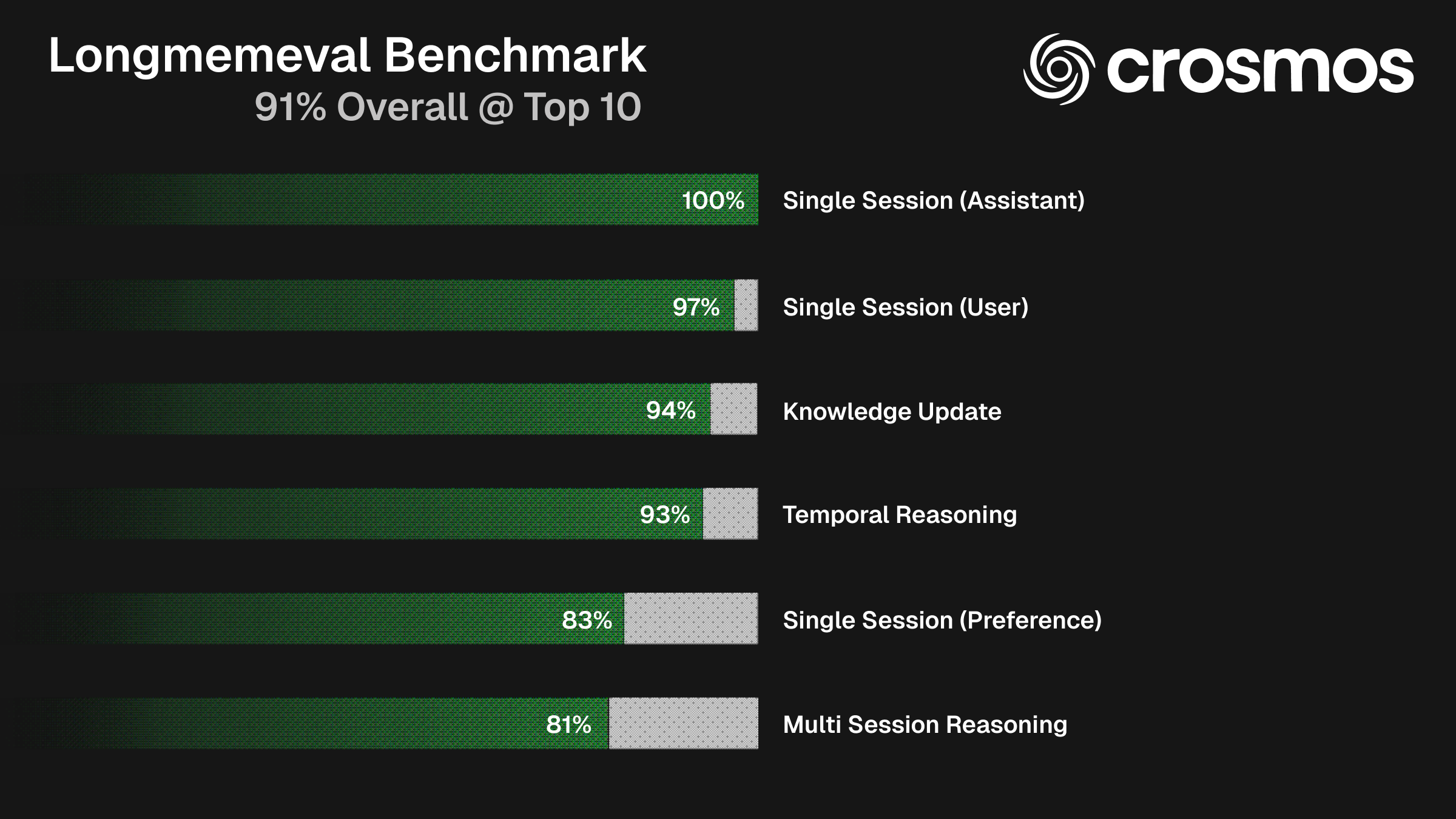
| Question type | Accuracy |
|---|---|
| Single-session (assistant) | 100.0 |
| Single-session (user) | 97.1 |
| Knowledge update | 93.6 |
| Temporal reasoning | 93.2 |
| Single-session (preference) | 83.3 |
| Multi-session reasoning | 81.2 |
| Overall | 90.8 |
And self-graded (gpt-5-mini), by category:
| Question type | Accuracy |
|---|---|
| Single-session (assistant) | 100.0 |
| Single-session (user) | 95.7 |
| Knowledge update | 93.6 |
| Temporal reasoning | 94.0 |
| Single-session (preference) | 76.7 |
| Multi-session reasoning | 83.5 |
| Overall | 91.0 |
Crosmos scores highest among production memory systems on LongMemEval-s:
| System | Answering model | LongMemEval-s |
|---|---|---|
| Crosmos (self-graded) | gpt-5-mini | 91 |
| Crosmos (gpt-4o) | gpt-5-mini | 90.8 |
| HydraDB | gemini-3-pro | 90.79 |
| Supermemory5 | gemini-3-pro | 85.20 |
| Zep6 | gpt-4o | 71.2 |
| Full context (baseline) | gpt-4o | 60.2 |
Crosmos reaches these numbers on gpt-5-mini, a small and cheap model. That a light model gets there points to the retrieval carrying the load, and it leaves headroom: a stronger answering model would push accuracy toward the recall ceiling.
Crosmos is shown under both its own grader and an independent one. Competitor scores are from HydraDB's evaluation 7.
5.3 What this means
Retrieval is at 99.7%, accuracy at 90.8%. So on the questions that are missed, the answer was in the returned context and the answering model did not use it. On the two hardest types, preference and multi-session, retrieval is near perfect, so the headroom is in answering, not memory. A stronger answering model walks accuracy toward the 99.7% ceiling.
6. What's new here
- Memory for a whole organization, with multiple people and permissions built into search, not a single user's history.
- Deterministic search that still reaches very high retrieval, 99.7% in the top 10.
- A full audit trail: every answer traces back to the memory and the source it came from, with history kept rather than overwritten.
7. What's next
LongMemEval measures personal recall, while the parts of Crosmos that set it apart, shared memory with permissions, forgetting, and consolidation, go untested by any public benchmark today. The next benchmark we are building measures those directly, starting with the one that matters most: whether a person sees exactly what they are allowed to and nothing more.
Reproducibility: the benchmark harness records the exact settings and dataset version for every run, grading uses the benchmark's official rubric unchanged, and search returns the top 10. The 99.7% figure is how often the answer-bearing item is in those 10.
Citations
Footnotes
-
Anthropic (2024). Introducing Contextual Retrieval. Anthropic Engineering Blog. https://www.anthropic.com/engineering/contextual-retrieval ↩
-
Liu, N. F., Lin, K., Hewitt, J., Paranjape, A., Bevilacqua, M., Petroni, F., & Liang, P. (2024). Lost in the middle: How language models use long contexts. TACL, 12, 157-173. ↩
-
Wu, D., Wang, H., Yu, W., Zhang, Y., Chang, K. W., & Yu, D. (2024). LongMemEval: Benchmarking chat assistants on long-term interactive memory. arXiv:2410.10813. ↩ ↩2
-
Maharana, A., Lee, D. H., Tulyakov, S., Bansal, M., Barbieri, F., & Fang, Y. (2024). Evaluating very long-term conversational memory of LLM agents. arXiv:2402.17753. ↩
-
Supermemory (2025). LongMemBench results. https://supermemory.ai/research/longmembench ↩
-
Rasmussen, P., Paliychuk, P., Beauvais, T., Ryan, J., & Chalef, D. (2025). Zep: a temporal knowledge graph architecture for agent memory. arXiv:2501.13956. ↩
-
HydraDB (2026). Beyond flat embeddings for production AI agents. https://research.hydradb.com ↩