
The Fragmentation Problem
Every company is sitting on an enormous amount of intelligence.
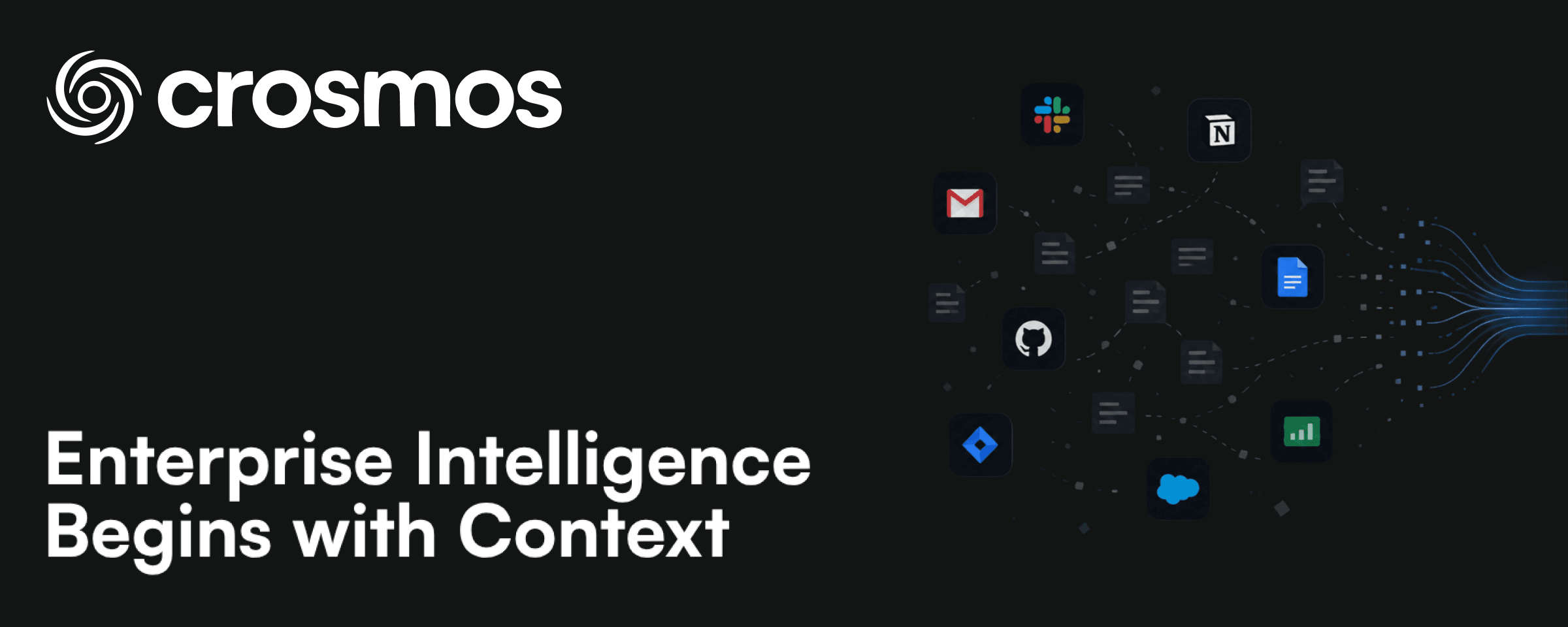
It exists in:
- Slack conversations
- Emails
- Product documents
- Meeting notes
- Customer tickets
- Git commits
- Roadmaps
- Decisions made in passing
- The institutional memory inside people's heads
The problem is that this intelligence is fragmented.
It is scattered across systems that were designed to store information, not to preserve context.
And until that context is unified, neither humans nor AI can reason effectively about how a company actually works.
The Fragmentation Problem
Companies do not suffer from a lack of information. They suffer from a lack of continuity.
A pricing decision might begin in a Slack thread, get debated over email, be summarized in a Notion document, implemented in code, reflected in Salesforce, and then partially remembered by a few team members.
The decision exists everywhere and nowhere at the same time.
It is embedded in a chain of discussions, assumptions, tradeoffs, and outcomes distributed across dozens of systems.
This is the fundamental problem of organizational context fragmentation.
The knowledge exists, but it is not represented as a coherent, queryable system.
Information Is Not Intelligence
Storing data is not the same as building intelligence.
Documents, messages, and tickets are raw artifacts.
Intelligence emerges when those artifacts are connected:
- Decisions linked to the discussions that produced them
- Tasks linked to the objectives they support
- Customers linked to the issues they experienced
- Code changes linked to the product rationale behind them
- People linked to the knowledge they contributed
Without these relationships, organizations are forced to reconstruct context manually every time a question is asked.
This reconstruction process is expensive, slow, and error-prone.
The result is repeated work, inconsistent decisions, and organizational amnesia.
The Cost of Fragmented Context
When context is fragmented:
- Teams repeat decisions that were already made.
- Institutional knowledge disappears when employees leave.
- Onboarding takes weeks or months.
- AI agents hallucinate because they lack grounding.
- Critical decisions become impossible to audit.
- Strategic reasoning depends on whoever happens to remember the answer.
At small scale, this feels like inefficiency.
At enterprise scale, it becomes a structural constraint on execution.
Why Enterprises Need an Intelligence Layer
Every company has systems to store data. Very few have systems to preserve understanding. There is no canonical representation of how the organization thinks.
No system that continuously captures:
- decisions
- assumptions
- dependencies
- outcomes
- historical evolution
This missing abstraction is the intelligence layer.
Its purpose is to transform fragmented information into a coherent representation of organizational knowledge.
Why Context Must Be Queryable
Knowledge is only useful if it can be interrogated.
Organizations should be able to ask complex questions to their agents about their own history and receive grounded answers.
Not documents.
Not keyword matches.
Answers.
Answers that are traceable to the underlying evidence and reproducible over time.
This is what makes organizational context operational.
Why Every Company's AI Agents Need Organizational Context
Model capability is no longer the primary constraint.
The limiting factor is access to accurate, structured organizational context.
Without context, AI systems operate with incomplete understanding.
With a queryable intelligence layer, they can reason using the same institutional knowledge that guides the company itself.
Because the relevant context can be retrieved precisely, organizations no longer need to send entire documents, long conversation histories, or redundant summaries to the model.
This reduces token usage, lowers inference costs, and improves response consistency.
As agent workloads scale, efficient context retrieval becomes both an intelligence advantage and an economic advantage.
This turns AI from a generic tool into a system that operates with organizational awareness.
Context Compounds
Organizational context is a strategic asset.
Each decision adds to a growing body of knowledge.
Each connection increases the organization's ability to reason, automate, and adapt.
Unlike models, which can be replaced, proprietary context accumulates over time. It becomes one of the few advantages that compounds.
The Foundation of Enterprise Intelligence
Enterprise intelligence is not defined by the sophistication of the model.
It is defined by the quality and accessibility of the context behind it.
The organizations that build a queryable intelligence layer will create systems that understand not just what exists, but why it exists.
That understanding will become the foundation for better decisions, stronger automation, and enduring competitive advantage.
Companies do not need more information. They need a system that understands how the organization actually works.
At @crosmoslabs , we are building the organizational context layer for companies and AI agents: a living, queryable, and auditable knowledge graph of the decisions, relationships, and institutional knowledge that defines how a company actually works.